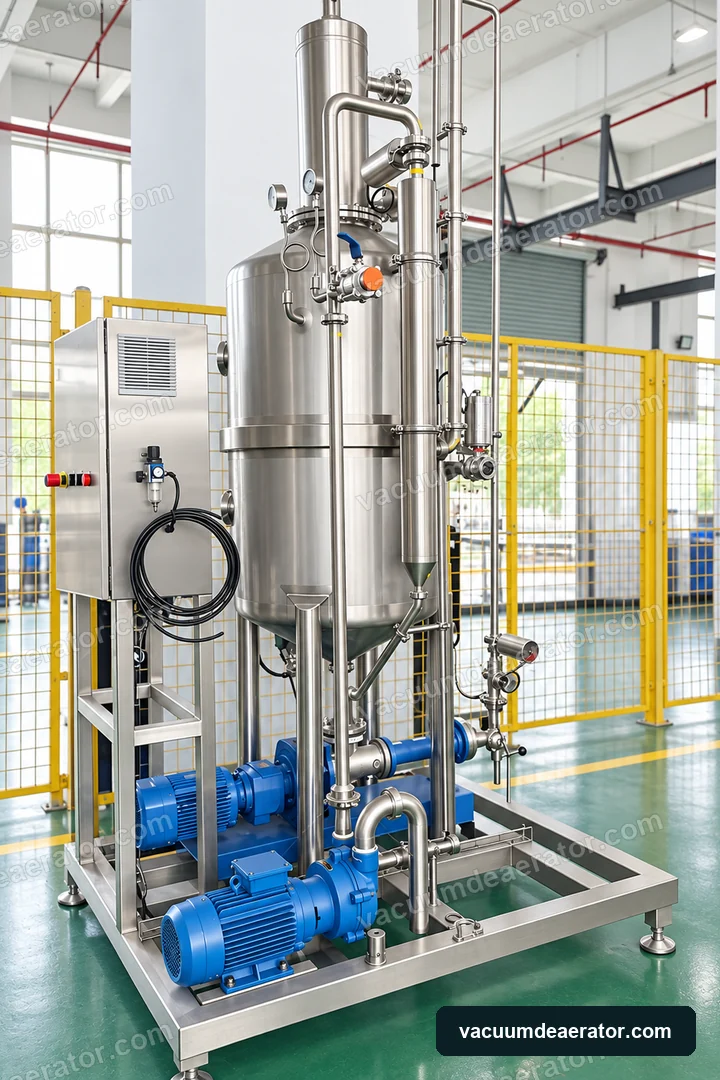
Food vacuum deaeration
The vessel is part of the equipment. The product defines the duty.
A continuous unit receives product, distributes it under reduced pressure, removes released gas and pumps the liquid onward through a closed path.
Juice, puree and sauce differ in viscosity, pulp, foam and temperature. Those differences guide the distribution method, vessel arrangement, gas handling and discharge pump.
Enquire about this equipmentStart with three details
Your product. Your flow. Your objective.
Tell us what you process, the approximate production rate and the air or oxygen problem you want to address.
Prepare your specification →Compare configurations
Choose the arrangement that fits your line.
These are equipment scope options, not fixed model or performance claims.
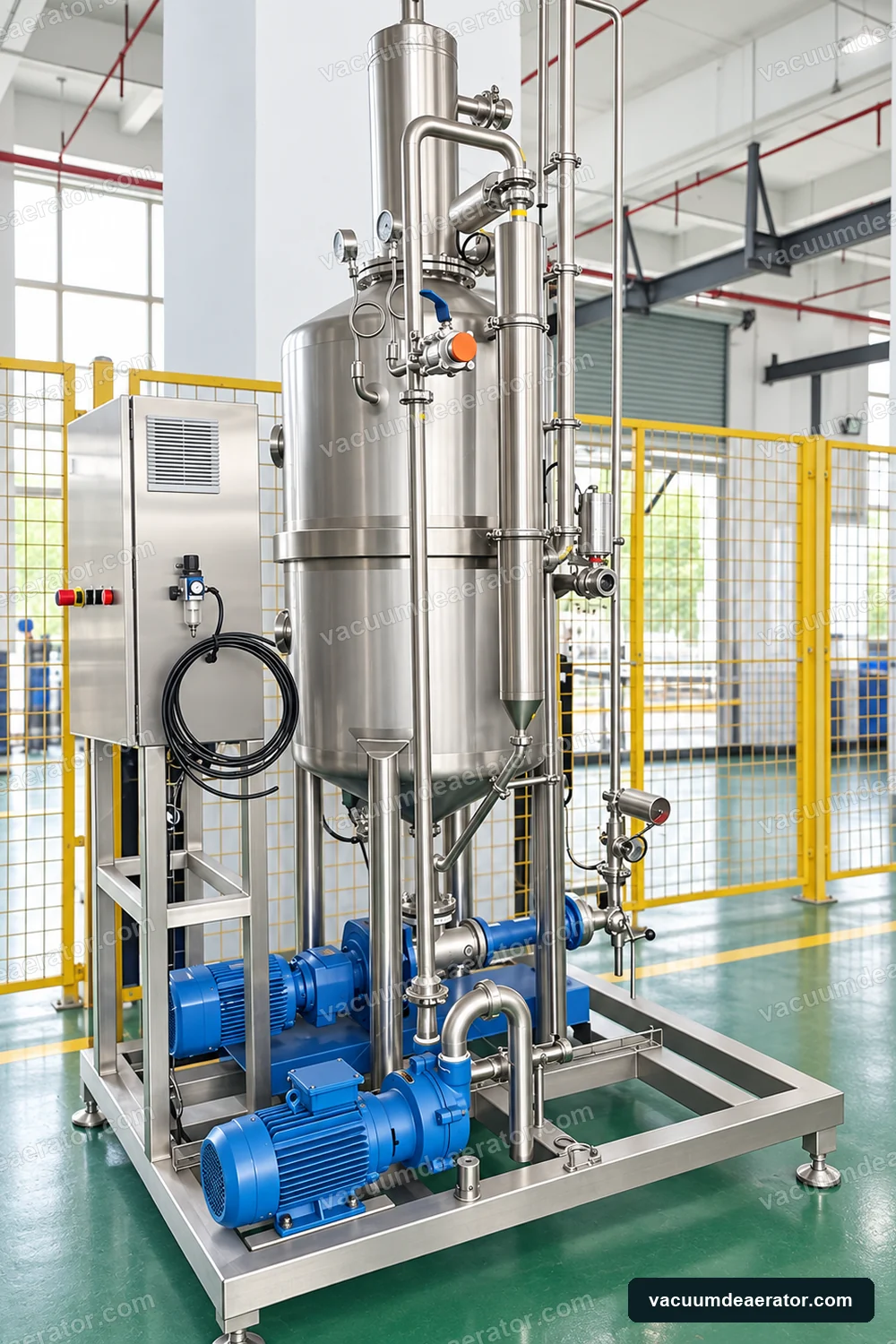
Coordinated equipment arrangement
Skid-mounted unit
Review vessel, pumps, controls and service access together. Define one practical interface with the surrounding line.
Explore the skid arrangement →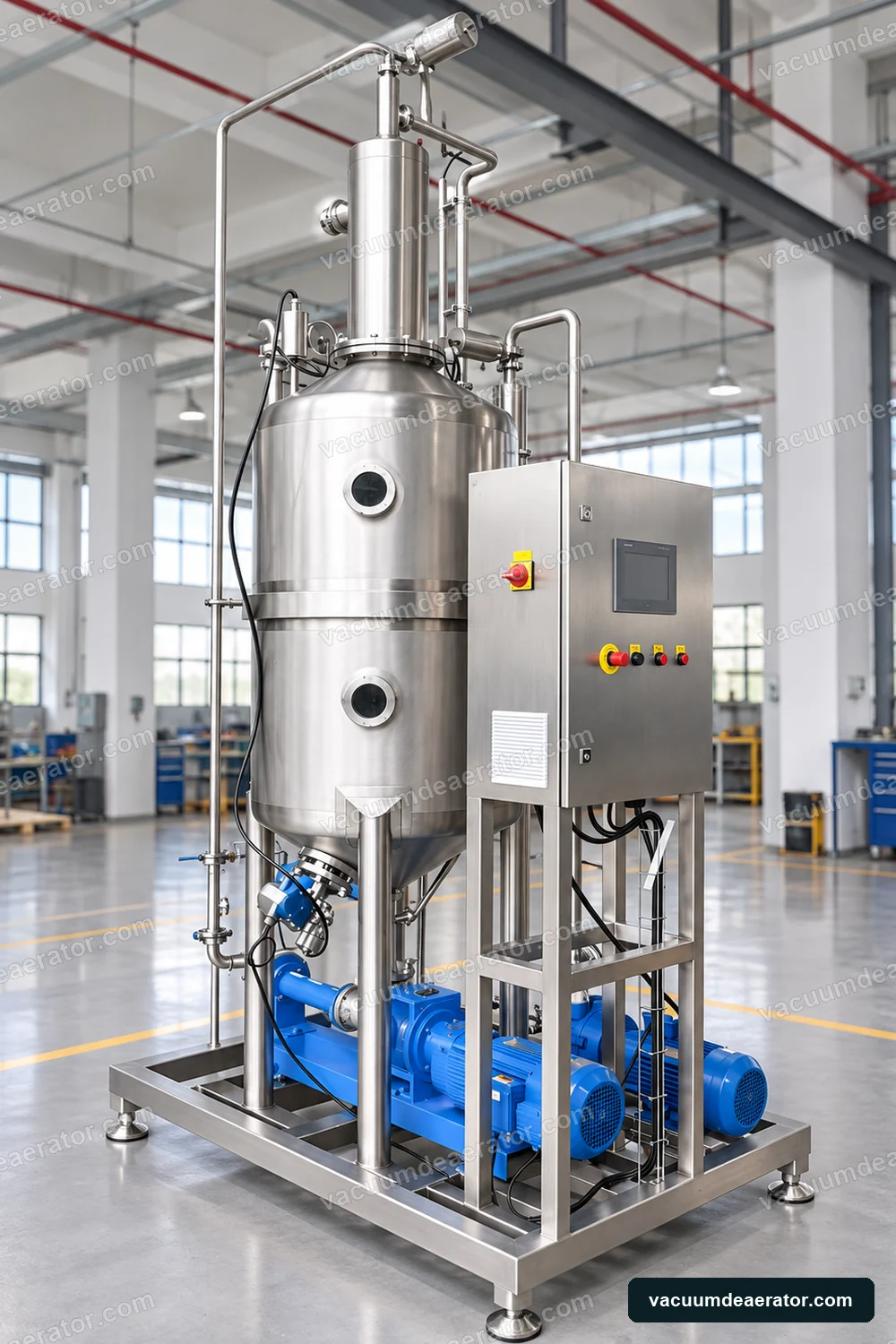
Product & gas handling
Vessel & vacuum system
Understand distribution, foam space, gas removal and closed discharge before comparing component choices.
Review the vessel and vacuum path →Equipment views
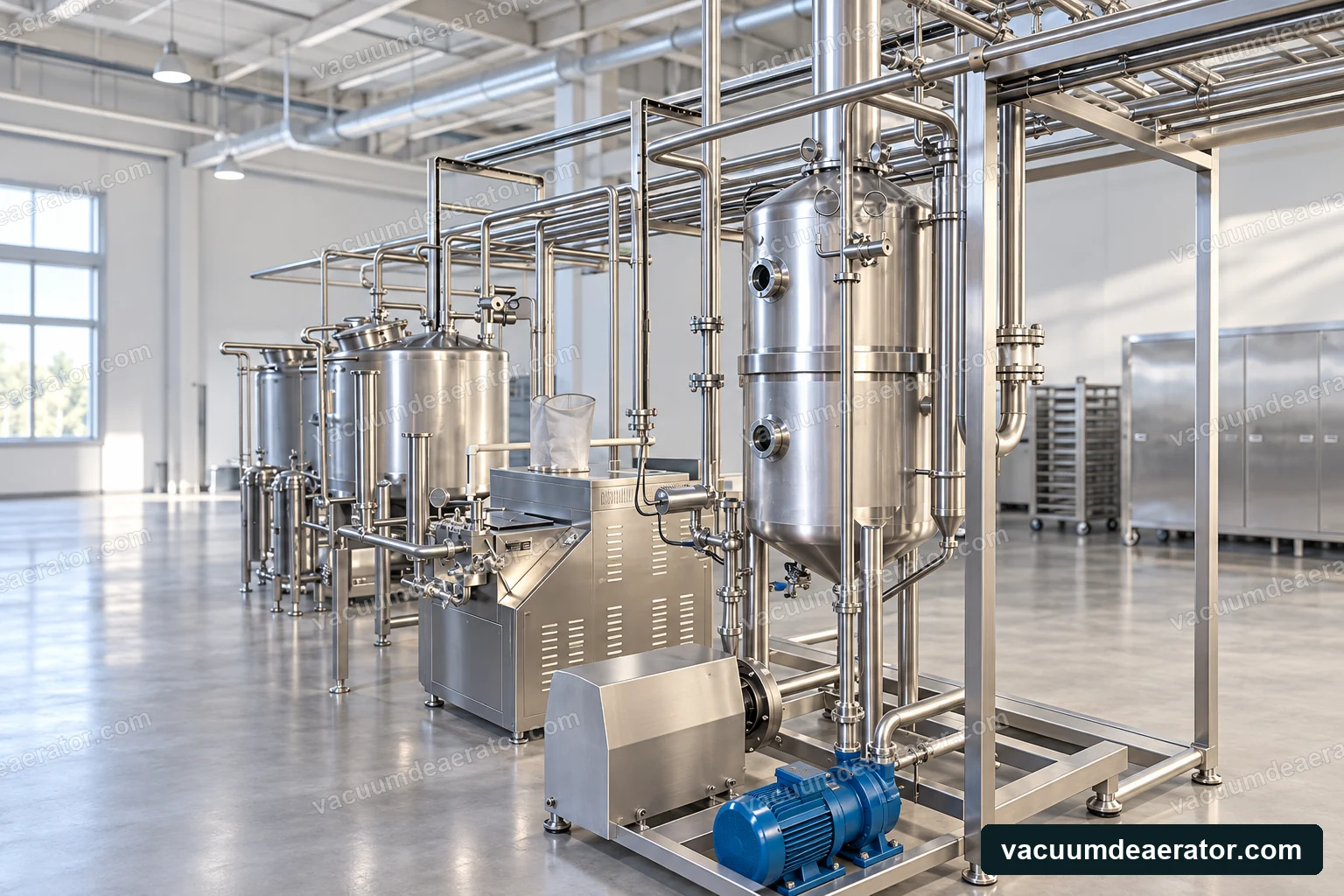
See the vessel, pumps and connections.
Edited equipment reference images show the arrangement for discussion. Final dimensions, materials and supplied components follow the agreed specification.
The product path
Five parts work together.
- 01FeedStable flow & temperature
- 02DistributeSurface area suited to the liquid
- 03Apply vacuumControlled gas-release conditions
- 04Handle gas & vapourVacuum and condensation scope
- 05DischargeClosed transfer to the next step
What changes the configuration?
Compare equipment on the same duty.
Use the same product and acceptance conditions when comparing proposals.
| Selection input | Why it matters | What to send |
|---|---|---|
| Operating flow | Distribution and level-control range | Minimum, normal and peak rate with units |
| Viscosity & particles | Product distributor, passages and pump | Temperature, test method, pulp and largest particle |
| Oxygen or air objective | Process condition and acceptance test | Inlet observation, target point and sampling method |
| Temperature & aroma | Vacuum, vapour and condenser duty | Inlet range and quality constraints |
| Cleaning | Internals, seals, access and drainage | CIP cycle and product changeovers |
| Installation | Frame, pipe connections and controls | Line sketch, headroom and utilities |
Application fit
Start with the liquid you process.
Apple juice
Define clear or cloudy juice, where air enters the process and where the oxygen result needs to hold.
Review this application →02 / ApplicationCitrus juice
Bring pulp, volatile aroma and operating temperature into the same discussion as oxygen removal.
Review this application →03 / ApplicationTomato puree
A thick product needs a distribution and pumping review before vessel capacity alone can describe the equipment.
Review this application →04 / ApplicationFruit nectar
Use the blended recipe and the process sequence to define the deaerator duty for a pulpy beverage.
Review this application →05 / ApplicationSauces
Start with the sauce recipe, particle limits and the air problem you need to solve.
Review this application →Compare applicationsNot sure where to start?
Compare juice, puree and sauce requirements and share your recipe for review.
View the application map →Equipment questions
Before requesting a quotation
Can I start without a complete technical specification?
Yes. Send the product, estimated flow and the problem you want to solve. Mark unknown values clearly so the configuration review can identify what else is needed.
Are the materials and capacity fixed?
The material, seal, operating range and performance objective must be specified for the actual product and installation. Reference images do not establish a fixed catalogue guarantee.
Does deaeration replace pasteurization?
No. Deaeration removes gas from the liquid. A required microbial-safety treatment needs its own validated process step.
Turn process data into a configuration
Discuss the machine and your process.
Tell us which product you process and what the deaerator needs to connect to. Technical values can follow during the configuration review.