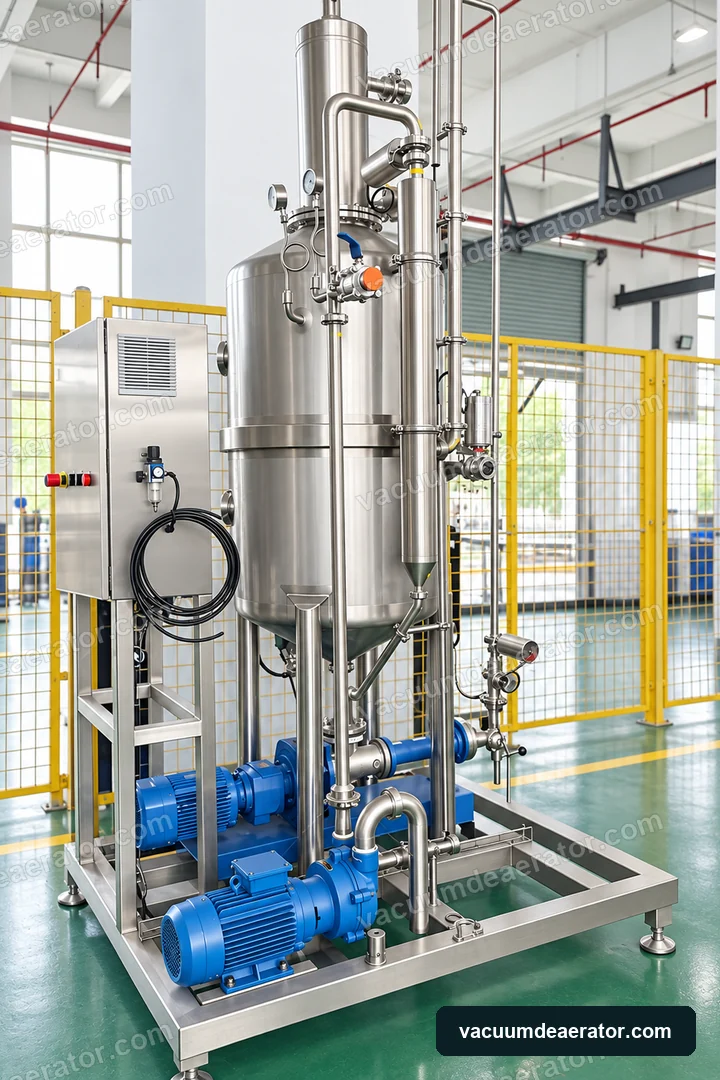
Configuration anatomy
One unit, five functions to define
A vacuum deaerator is often described by its vessel. In operation, the result depends on a chain: feed condition, product distribution, vacuum and vapour handling, level and foam control, and closed discharge.
A change in one section moves the operating window for the others. A thicker product can change the distributor and pump. A foaming product can reduce the usable headspace. A higher inlet temperature can increase the vapour load. The equipment review has to hold those effects together.
Use the sections below to identify what the proposal must state, what remains an open item, and what evidence belongs in an acceptance test.
Functional map
The sections that create the operating window
These are functions to specify, not a claim that every unit contains the same components or controls.
- 01
Feed & preheat
Stable flow and a known inlet temperature. Heating may be upstream, in scope, or not required.
- 02
Distribution
Spray, film, centrifugal or packed surface. The choice follows viscosity, pulp, particles, foam and cleaning.
- 03
Vacuum & vapour
Vacuum source, condenser, exhaust and instrumentation reviewed as one gas-handling duty.
- 04
Level & foam
Liquid level, headspace and pressure ramp protect residence time and the vacuum path.
- 05
Discharge
A pump and closed transfer that maintain the vacuum boundary to the next process step.
Line position
Where the unit sits changes the duty
There is no universal installation point. The position follows the air-entry risks, the heat-treatment sequence and the point where oxygen must remain controlled.
Example only. The actual position, heating scope and sampling points must be confirmed against the product and line.
01 / Feed condition
Feed and preheat set the starting condition
Flow stability and inlet temperature determine what the distributor and vacuum system receive. A unit sized only for a normal flow can behave differently at start-up, low-flow operation or a recipe change.
Preheat is a line decision, not a universal setpoint. Some products are deaerated at ambient or chilled temperature. Others are heated upstream for enzyme inactivation or preservation. Raising the temperature lowers gas solubility, but it also raises the vapour load and can change aroma, colour or foam behaviour.
If heat treatment is upstream, the deaerator receives the conditioned product and the review should use that condition. If a heater is in the supplied scope, its control, utility demand and product-temperature limit must be stated explicitly. Rapid cooling after preheat may be needed for product quality; that cooling step belongs in the line discussion even when it is not part of the deaerator supply.
State the actual inlet range and the allowable change through the unit. A temperature that works for one juice is not a specification for a puree, sauce or aroma-sensitive stream.
02 / Surface generation
Distribution turns a liquid stream into gas-release surface
The distributor creates the surface area from which dissolved and entrained gas can leave the product. Vacuum alone is not the mechanism. A thin film, small droplets or a repeatedly renewed surface shortens the distance the gas has to diffuse.
Common approaches include spraying through a nozzle, spreading product by centrifugation, distributing it over packing or trays, or another product-specific arrangement. The right method depends on viscosity, pulp, particles, foam and cleaning access. A nozzle that works for clear juice may block, wear or fail to spread a pulpy or viscous product.
Ask for more than a component name. The proposal should describe the design flow range, passage or orifice basis, turndown, pressure drop, access for inspection and the cleaning method. If the product behaviour is uncertain, a sample observation or trial is more useful than a catalogue viscosity limit from another liquid.
03 / Gas handling
Vacuum and vapour handling are one duty
The vacuum system maintains the reduced pressure above the product and removes the gas load that leaves the liquid. That load can include released air, water vapour and volatile compounds. A pump designation alone does not describe the complete duty.
The vacuum source may be a liquid-ring pump, a dry pump, an ejector or another arrangement. Each has different seal-water, cooling, exhaust and maintenance implications. The proposal should name the type, materials, seal or cooling-water requirement, exhaust route and control method.
When the vapour load is significant, a condenser reduces the load reaching the vacuum pump. Cooling-water temperature and operating pressure affect how much vapour is condensed. For an aroma-sensitive product, the condenser and condensate path are also quality decisions: volatile flavour components can enter the vapour stream, and the chosen condensation arrangement affects what is recovered or lost.
Instrumentation and leak tightness belong in the same review. A vacuum transmitter, gas-path temperature, cooling-water condition and pump status are more useful than a single gauge reading. The exhaust must be routed safely and must not create a new restriction or re-entry path.
04 / Stability
Level and foam control protect the operating window
Level control maintains the liquid surface, the available residence and the separation space above the liquid. It coordinates incoming product with discharge so the vessel does not flood or run dry during start-up, normal running, shutdown or cleaning.
The level instrument must suit the actual product and vessel. Radar, guided-wave, differential-pressure, capacitance and other methods behave differently with foam, build-up, conductivity and hygienic cleaning. The control output may act on a feed valve, a feed pump or the discharge pump; the proposal should state which.
Foam is a separate control problem. When pressure falls, dissolved and entrained gas can form foam faster than it collapses. Foam can fill the headspace, reduce the effective surface area, disturb the level reading or carry product into the vacuum line. Headspace, inlet gas content, pressure ramp, distribution and foam detection all belong in the review.
Antifoam is not a universal solution. Its permitted use, labeling effect and influence on the product must be established for the recipe. If foam behaviour is unknown, observe the actual product under vacuum before fixing the control strategy.
05 / Closed transfer
Discharge keeps the vacuum boundary closed
The discharge pump removes product while the vessel remains under vacuum. It has to work with the suction condition at the vessel outlet and the pressure required by the next process step. A pump selected only from a catalogue flow rate is not a complete selection.
Pump type follows viscosity, particles, suction performance, downstream pressure and cleaning. A centrifugal, lobe, progressive-cavity or other arrangement can each be appropriate in a different duty; the proposal should state why the chosen type fits this product and this installation.
The transfer path matters as much as the pump. Open tanks, splashing, leaking seals, poor pipe routing and unnecessary breaks in the closed path can reintroduce air after the deaerator. If the oxygen objective is measured downstream, those risks belong in the acceptance boundary.
Limits
What this equipment review does not claim
A clear boundary makes the proposal easier to compare and the acceptance test easier to defend.
Process limits
- It is not a sterilization or pasteurization step.
- It is not a guaranteed deodorization step.
- It does not repair an open tank, a leaking suction line or a repeated downstream air entry.
- A vacuum reading is not a dissolved-oxygen result.
Evidence limits
- No universal outlet oxygen value is promised for every product.
- A result from another recipe is not transferred without evidence.
- Foam, rheology and aroma may require a sample or trial.
- Final materials, utilities and performance basis belong in the quotation.
Selection inputs
The data that changes the configuration
Send what is known and mark what is estimated. The review can proceed with open items; it cannot proceed safely with invented values.
| Input | Why it changes the machine | What to send |
|---|---|---|
| Product & recipe | Distribution, materials, cleaning and foam behaviour | Recipe, solids, pulp, particles, aroma sensitivity |
| Flow range | Distributor turndown, level control and pump range | Minimum, normal and maximum with units |
| Temperature | Gas solubility, vapour load and product quality | Inlet range, heating step and allowable change |
| Rheology | Spreading, passage size and discharge pump | Viscosity, method, temperature and shear notes |
| Foam | Headspace, level strategy and vacuum path protection | Observation, test condition, antifoam policy |
| Oxygen objective | Acceptance point, sampling and downstream protection | Inlet value, target, instrument and measurement point |
| Utilities | Vacuum source, condenser and control scope | Cooling water, power, air, seal water and exhaust |
| Cleaning & installation | Access, drainage, connections and service space | CIP cycle, line sketch, headroom and floor space |
Configuration questions
Before fixing the process sections
Can one unit handle clear juice and a viscous puree?
It may be possible, but the distributor, discharge pump, turndown, cleaning and level strategy must cover both products. Share both recipes and operating ranges; a trial may be needed before the configuration is fixed.
Is preheating always required?
No. It depends on the product and the surrounding process. Heating can increase gas release, but it also raises the vapour load and may affect aroma or colour. State the actual inlet condition and whether the heater is upstream or in scope.
How is foam controlled?
Start with the product's foam behaviour and the available headspace. Distribution, inlet gas content, pressure ramp, level strategy and foam detection may all matter. Antifoam is considered only where its use is permitted for the recipe.
Can a dissolved-oxygen value be guaranteed?
A project-specific acceptance value can be defined with the product, operating conditions, sampling method and measurement point. A universal guarantee is not published because the duty changes with the product and line.
Which vacuum pump is used?
The vacuum source is selected for the gas and vapour load, available utilities and installation constraints. The proposal should name the type, materials, seal or cooling requirement and exhaust arrangement.
Technical basis
Sources behind the process statements
These references support general process principles. They do not transfer another manufacturer's model performance to this site.
Turn process data into a configuration
Discuss the machine and your process.
Tell us which product you process and what the deaerator needs to connect to. Technical values can follow during the configuration review.